One Boot by the Stove: A Solo Walker's Way Into Rifugio Life
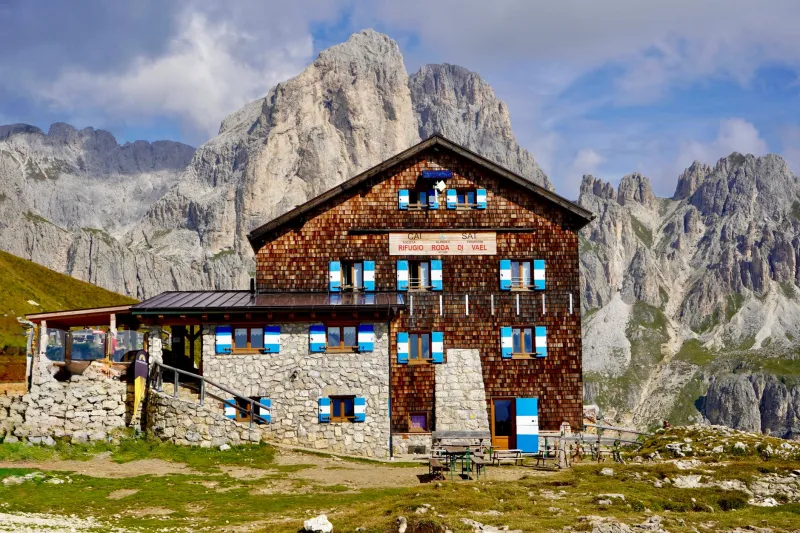
Photo: Marinofarallos, CC BY-SA 4.0, via Wikimedia Commons
Solo walking in the Alps has a reputation problem. People imagine a lone figure on a ridge, wistfully eating a squashed sandwich while a distant group laughs around a table. The reality, especially in Italian rifugi, is usually far warmer and far less dramatic. You arrive with your own pace, your own thoughts and your own rucksack; by the time the polenta comes out, you're passing the cheese to someone from Munich and arguing gently about whether the pass tomorrow is easier from the north.
That doesn't mean you have to become the life and soul of the hut. It means you can treat your solo status as a bit of useful freedom: the freedom to choose the dorm, to sit where you like, to go to bed at half eight if your legs say so. The trick is knowing how the evening works before you walk through the door.
Dinner is a group project, not a dinner party
In most staffed Italian rifugi, dinner is a single sitting at a set time. You don't book a table for one; you turn up, find a spot and sit down. Tables are often long, benches are shared and the menu is whatever the kitchen has made - which is exactly why it works. There's no performance to it. You're not hosting; you're just eating supper with a room full of tired walkers.
If you're nervous, arrive a few minutes early rather than late. Early means you can choose a seat near the edge of a table, which feels less like interrupting a conversation. A simple "buonasera" and a nod does more than you'd think. Most people will assume you're on the same route as them and ask where you've come from. That question is the whole icebreaker. You don't need a script; you just need to have walked somewhere that day.
And if you'd rather eat quietly? That's allowed too. Bring a small notebook, read a page of your map, or just watch the light go orange on the peaks. The hut isn't a networking event. It's a shelter with soup.
Dorm or private room? Choose the night you actually want
A lot of solo travellers automatically book a private room for fear of the dorm. Sometimes that's the right call - especially if you've had a long travel day, you're a light sleeper or you've got an early start. But don't rule out the dorm by default. In a busy rifugio, the dorm is often where the casual chat happens: the rustle of map bags, the quiet comparison of blisters, the shared hunt for a spare earplug.
A good compromise is to mix it up. Take a dorm on the first night of a trip when you're still energised and curious; book a private room on the last night when you want to pack in peace. If you're going for a dorm, aim for a hut with a reputation for being sociable rather than remote - the busy ones on popular traverses tend to have more solo walkers and more relaxed chat. The quieter huts are lovely, but they can feel more like a family living room, which is charming if you're in the mood and awkward if you're not.
Small rituals make arriving alone feel deliberate
Solo travel feels best when it looks like a choice rather than a gap. A few tiny rituals help. When you arrive, don't dump your bag and hide. Take five minutes to sort your boots, fill your water bottle, and look at the noticeboard. Say hello to the keeper when you pay. Ask what time dinner is, even if you already know. These small transactions make you a person in the room rather than a ghost at the edge of it.
Then give yourself a job. Mine is always the same: find the stove, put my flask next to it and claim a corner of the bench. That little patch becomes my base. People talk more easily when you're doing something ordinary - drying socks, studying a map, writing a postcard. You don't need to launch a conversation. You just need to be visibly at ease.
How to join in without forcing it
You'll meet two types of hut evenings. Some are quietly communal: everyone eats, everyone chats a bit, everyone is asleep by ten. Others are properly sociable, with a shared jug of wine and a keeper who enjoys a bit of theatre. Read the room. If the table is deep in conversation, ask one small question rather than trying to change the subject. "Is the path down to the valley as loose as it looks?" works every time. So does "What's the soup?"
Don't feel you have to stay up. The beauty of arriving alone is that you can leave the table when you're done. A polite "buonanotte" as you go is enough. Nobody is marking your social performance out of ten.
The quiet wins of going up alone
There are real pleasures to a solo rifugio night that group travel can't quite replicate. You get the bunk you want. You can change your plan over breakfast without a committee meeting. You notice more: the clatter of the kitchen, the smell of woodsmoke, the way the clouds sit below the window at dusk. And because you're not anchored to a group, you're more likely to fall into conversation with the person opposite - the Dutch couple on their first hut trip, the Italian father teaching his daughter to play cards, the fellow Brit who also underestimated the descent.
Going solo doesn't mean being alone all evening. It means you get to choose the shape of the evening. Some nights that's a long chat by the stove; others it's a bowl of barley soup and an early bunk. Both are good. Both are the point.
A few practical notes for UK walkers
Book ahead in July and August, even for a dorm; the popular huts fill up and a solo bed is still a bed. Take earplugs, a headtorch and a lightweight sleep sheet. Carry cash for drinks and extra courses, and check whether the hut takes cards - many do now, but not all. If you're arriving by train and bus, aim for a hut within a few hours' walk of the road so your first day doesn't become a race. And tell someone at home your route, even if it's just a text from the valley.
Most of all, don't wait for a companion to book the trip. The rifugio doesn't need you to arrive in a pair. It just needs you to turn up, take your boots off and sit down. The rest tends to sort itself out somewhere between the first course and the last of the light.